This article has been adapted from insights provided by Alison Richmond of Provention, creator of First Move Training, which is delivered in Northland by AIM.
Most managers who contact Alison and her team at Provention describe the same frustrating pattern:
-
- Manual handling training gets delivered
- Attendance is recorded
- Staff can repeat the usual lines
- Strain and sprain injuries continue
If your injury numbers aren’t shifting, it’s not because your people don’t care.
It’s because most manual handling training was never designed to create lasting movement change under real workplace pressure.
Manual Handling Isn’t a Knowledge Problem
Manual handling injuries are not:
-
- A motivation problem
- An effort problem
- A “people don’t know the rules” problem
Manual handling injuries are a movement habit problem.
In real work environments – fast pace, awkward loads, tight spaces, fatigue – people don’t rise to the level of training. They fall to their level of movement habit.
And most training programmes don’t build new movement habits.
The Real Issue: Most Training is Designed for Audit, Not Outcomes
Traditional manual handling courses often:
-
- Transfer information
- Present sensible-sounding rules
- Collect signatures
- Tick compliance boxes
But movement is a physical skill, not a theory subject. Telling people:
-
- “Keep your back straight”
- “Bend your knees”
- “Don’t twist”
This all sounds logical in a classroom setting. But on a noisy floor? Under pressure? Mid-shift? Those rules nearly always collapse.
If It Can’t Be Coached in 10 Seconds, It Won’t Stick
That’s not a slogan. It’s just operational reality.
Workers can’t mentally “recall the right page in the manual” when:
- The job is fast
- The load is awkward
- The space is tight
- The shift is long
The organisations that consistently reduce strain and sprain injuries take a different approach – they build a shared movement language.
- Short coaching cues
- Felt difference (“this feels strong” vs “this feels strained”)
- Repetition until it becomes automatic.
Safe movement isn’t a rule people try to remember. IT’S A REFLEX THEY DEFAULT TO UNDER PRESSURE.
The First Move Predicts the Whole Move
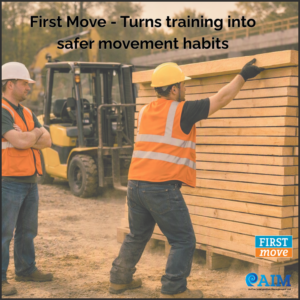
The First Move Training Method is built on a simple principle –
The first move predicts the whole move.
If the first move is off – balance, hip position, foot direction, shoulder alignment – the rest of the movement is compromised.
Compromised movement under load is where strain builds:
-
- Lower spine absorbs twist
- Shoulders overload
- Elbows and forearms fatigue
- Micro-strains accumulate
But when the first move is organised:
-
- Effort reduces
- Control improves
- Fatigue accumulates more slowly
- Repeat injuries decrease
How Can You Prevent Sprains & Strains from Manual Handling – in Northland?
In Northland, AIM’s qualified trainers deliver the First Move Training – How to Prevent Strains & Sprains from Manual Handling.
This isn’t another compliance exercise.
It is practical, movement capability training designed to:
-
- Build automatic movement habits
- Reduce strain and sprain injuries
- Improve physical resilience across shifts
Don’t rely on people remembering complicated rules and body instructions. Use simple cues that are easy to apply in any situation, so movement habits become automatic, starting with the first move.
If your organisation is tired of repeating training without seeing results, it may not be your people. It may be the training model.
Click this link to find out more about bringing First Move Manual Handling training to your team, or contact us and we’ll work with you to find a solution to improve your workplace safety and wellbeing.