This article has been adapted from insights provided by Alison Richmond of Provention, creator of First Move Training, and delivered in Northland by AIM’s expert trainers.
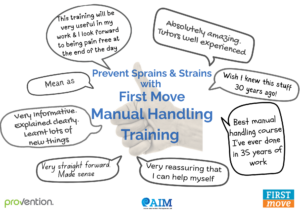
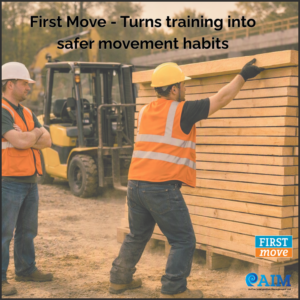
First Move Manual Handling Training focuses on practical movement skills that workers can immediately apply in everyday tasks.
Many organisations tell us the same thing:
“Our team are practical people. They don’t learn well sitting in a classroom. They need hands-on training.”
They’re absolutely right.
But here’s the thing: that doesn’t just apply to warehouse staff, healthcare workers, vineyard teams, or manufacturing employees. It applies to everyone.
Whether you’re a CEO, a manager, a health and safety advisor, or a frontline worker, physical skills are learned the same way – through experience, practice, and repetition.
Physical Skills Can’t Be Learned Through Theory Alone
You can read about lifting techniques. You can understand anatomy. You can sit through presentations and watch videos.
Learning a concept intellectually doesn’t automatically translate into better movement.
Feeling physical movement is different from learning knowledge.
Understanding how to move safely, efficiently, and with less strain requires people to feel the difference in their own bodies. That’s how new movement habits are formed.
Physical Intelligence Exists at Every Level of an Organisation
Over the years, we’ve seen that physical intelligence has very little to do with job title, education, or experience.
Some people naturally move well. Others don’t.
Alison has worked with senior leaders who thoroughly understood their injuries and the theory behind them, yet continued to experience pain until they physically experienced a different way of moving.
Small adjustments to posture, grip, balance, or body position can dramatically change the forces placed on the body. Once people feel that difference themselves, the learning becomes far more powerful than any explanation.
Why Even Sceptical Workers Engage
Many managers worry that some employees won’t take manual handling training seriously.
In reality, people are often sceptical because of their previous experiences.
They’ve sat through presentations, watched slides, and listened to instructions that didn’t seem relevant to the work they actually do.
When training becomes practical and participants can immediately feel the difference between a movement that creates strain and one that feels stronger or easier, engagement changes.
The most experienced and sceptical workers are often the first to recognise when something genuinely works.
Physical Learning Overcomes Language Barriers
Traditional safety training can sometimes struggle when teams speak multiple languages.
However, movement is something everyone understands.
When people physically experience a safer or more efficient way of working, the learning doesn’t rely solely on spoken or written instructions.
Supporting resources are still important, but the most powerful learning happens through experience.
This practical approach was one of the key elements behind the success of Provention’s First Move programme at NZ Safety Blackwoods, where significant reductions in workplace injuries were achieved.
What This Means for Manual Handling Training
If workers aren’t engaging with manual handling training, it may not be because they’re difficult to train.
It may be because the training focuses too heavily on theory and not enough on practical skill development.
Building safer movement habits requires:
- Practical, hands-on learning
- Immediate feedback
- Real-world workplace relevance
- Ongoing reinforcement
The same principles apply whether someone is new to the job or leading the organisation.
Final Thought
When organisations say their people won’t engage with manual handling training, perhaps the better question is:
“Are we teaching physical skills in a way that people can actually learn?”
Because safe manual handling isn’t simply about understanding information.
It’s about experiencing, practising, and reinforcing better ways of moving every day.
Interested in a session for your team?
Whether you’re looking to book an on-site workshop or register interest in a future public session, we’d love to hear from you. Read more about the workshop here