Many people use the terms wellness and wellbeing interchangeably – but are they actually the same thing?
From fruit bowls and step challenges to yoga sessions, meditation apps, and wellbeing workshops, there is no shortage of initiatives designed to support employee health.
These activities can be valuable. They encourage healthy habits, provide opportunities for connection, and demonstrate that an organisation cares about its people.
But are wellness and wellbeing actually the same thing?
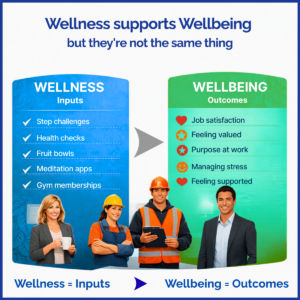
Wellness Is an Activity.
Wellbeing Is an Outcome.
The terms are often used interchangeably, but there is an important distinction.
Workplace wellness refers to the programmes, initiatives, and activities that support healthy behaviours. For example –
- Health checks
- Fitness challenges
- Healthy eating initiatives
- Mindfulness programmes
- Gym memberships
- Educational workshops
Workplace wellbeing, on the other hand, is how people actually feel.
Do employees feel supported, valued, connected, and able to cope with the demands of their role? Do they find meaning in their work? Are they engaged and motivated, or are they feeling stressed, overwhelmed, and exhausted?
Wellbeing is the outcome.
Wellness initiatives are just one of the many factors that may contribute to it.
When Isn’t Wellness Enough?
An organisation may offer excellent wellness programmes and still have employees experiencing poor wellbeing.
Why?
Because wellbeing is influenced by much more than access to healthy activities.
Factors such as workload, leadership, workplace relationships, role clarity, flexibility, support, job control, and the organisational culture all play a significant role in how people experience their work.
An employee might enjoy participating in a lunchtime walking challenge, but if they are consistently working excessive hours, experiencing workplace conflict, or feeling unsupported by their manager, their overall wellbeing may still suffer.
Wellness initiatives can help people manage stress, but they do not necessarily remove the sources of stress.
The Link to Psychosocial Risks
This distinction is becoming increasingly important as organisations focus more attention on psychosocial risks in the workplace.
Psychosocial hazards are aspects of work that have the potential to negatively impact a person’s psychological health, wellbeing, or ability to perform their job effectively. (read more on Psychosocial Risks in the Workplace here).
These may include:
- High or sustained workloads
- Low levels of support
- Poor communication
- Workplace conflict
- Unclear roles and expectations
- Lack of control over work
- Exposure to traumatic events
- Bullying and harassment
Addressing psychosocial risks is not simply about offering more wellness programmes. It requires organisations to examine the workplace factors that may be contributing to stress, fatigue, disengagement, or poor mental health.
In other words, it involves looking beyond the ‘fruit bowl’.
Measuring What Really Matters
Researchers from Oxford University’s Wellbeing Research Centre have highlighted another important distinction: the difference between wellbeing drivers and wellbeing outcomes.
Drivers are the factors that influence wellbeing, such as pay, leadership, flexibility, workload, and job design.
Outcomes are how people actually feel as a result.
If organisations only measure the drivers, they may miss the bigger picture. A workplace can have policies, programmes, and initiatives in place, but the most important question remains –
Are people actually experiencing positive wellbeing?
Some researchers suggest that organisations should regularly ask employees simple questions such as:
- How satisfied are you with your job?
- How meaningful do you find your work?
- How happy have you felt at work recently?
- How stressed have you felt at work recently?
While these questions don’t tell the whole story, they can provide valuable insight into whether workplace wellbeing is improving over time.
Many organisations genuinely care about their employee’s wellbeing.
The challenge is that wellbeing isn’t always improved by adding another programme or initiative. Sometimes the biggest gains come from addressing workplace factors such as workload, communication, support, role clarity, and workplace culture.
Creating Healthier Workplaces
Wellness initiatives still have an important place in supporting employee health and engagement – but they are most effective when they form part of a broader approach to workplace wellbeing.
Creating a healthy workplace means looking not only at the programmes offered to employees, but also at the systems, culture, leadership practices, and work design that influence how people experience work every day.