October is Ergonomics Month!
So we thought we’d take a closer look at workplace ergonomics.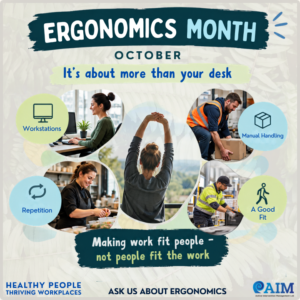
When you hear the word ergonomics, you might think of office chairs, desks, mice, keyboards and computer screens.
And while a workstation setup is certainly part of ergonomics, it’s only one piece of the puzzle.
Ergonomics is about understanding how people interact with their workplace – including the tasks they perform, the equipment they use and the environment they work in – and looking for ways to make that fit work better.
Good ergonomics isn’t about asking people to simply adapt to a job.
It’s about asking: Does the work fit the people doing it?
Ergonomics is about more than your desk
A good ergonomic approach can apply to almost any workplace – from an office or healthcare setting to a warehouse, workshop or construction site.
It can involve looking at:
- how a workstation is set up
- how people lift, carry, push and pull
- repetitive tasks and movements
- awkward or sustained postures
- the equipment people use
- the layout and environment
- how tasks are organised and performed
- whether there are opportunities to vary tasks and movement.
Sometimes, relatively small changes can make a meaningful difference.
How we move matters too
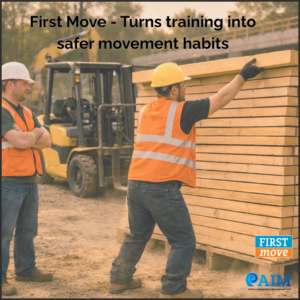
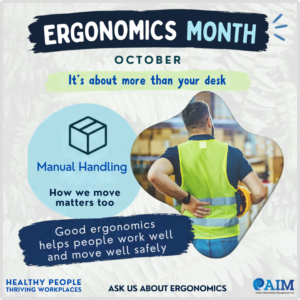 Manual handling is a good example.
Lifting, carrying, pushing and pulling can place demands on the body, particularly when the load, task or environment isn’t well suited to the person doing the work.
An ergonomic approach doesn’t simply ask: “Are people lifting correctly?”
It also asks: “Could we make the task itself easier or safer?”
That might mean considering the size or weight of a load, the equipment available, the layout of the workspace, the distance something needs to be moved or the way the task is organised.
Looking at the task as a whole can help identify practical ways to reduce unnecessary strain.
Does your workstation work for you?
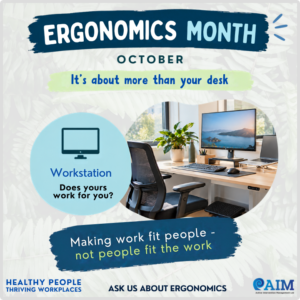 Workstations are probably the most familiar example of ergonomics.
But there isn’t one “perfect” workstation setup that works for everyone.
The right setup depends on the person, the work they do and how they use their equipment.
Screen height, keyboard and mouse position, chair adjustment, foot support and the amount of movement throughout the day can all influence how comfortable someone is.
And sometimes the solution isn’t buying a new chair or desk. A few simple adjustments can make a surprisingly big difference.
At AIM, our Workstation Assessments look at the individual, their work and their environment to identify practical changes that can support comfort and healthy working habits.
Small movements. Big impact.
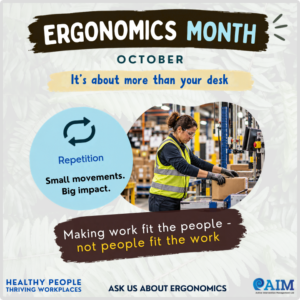 Ergonomic risk isn’t always caused by one big or obviously awkward movement.
Sometimes, it’s the things we do over and over again that add up.
Reaching, gripping, lifting, typing, bending, twisting or working in the same position for long periods can place repeated demands on the body.
Good ergonomics means looking at how the work is done and asking whether there are ways to:
- vary the task
- change the setup
- use equipment differently
- reduce unnecessary repetition
- build in more opportunities to move.
Our bodies are designed to move – and variety matters.
Is the work a good fit?
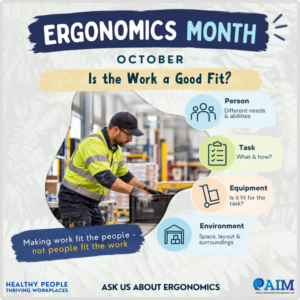 People come in many different shapes, sizes, strengths, ages and abilities.
Tasks, equipment and workplaces aren’t one-size-fits-all either.
That’s why good ergonomic design looks at the whole picture:
Person – What does the person need to do the job comfortably and safely?
Task – What needs to be done, and how?
Equipment – Is it fit for purpose and suitable for the people using it?
Environment – Does the space, layout and surrounding environment support the task?
When these things work well together, the job can become easier, more comfortable and more sustainable.
And when they don’t, people start compensating – reaching further, twisting, bending, repeating movements or working in awkward positions simply because that’s what the job requires.
Sometimes, the solution isn’t changing the person.
It’s changing the way they work.
What could you change?
Good ergonomics doesn’t necessarily require a major workplace overhaul. Start by looking at the tasks your team does regularly and asking:
-
- Is there unnecessary reaching, bending or twisting?
-
- Are people repeating the same movement for long periods?
-
- Could the task be varied?
-
- Is equipment being used in the best way?
-
- Could the workspace or layout be changed?
-
- Does the equipment actually fit the person and the task?
-
- Are there simple changes that could reduce physical strain?
And importantly, ask the people doing the work.
They often know exactly where the awkward, repetitive or frustrating parts of a task are.
How AIM can help
At AIM, our workplace health professionals can help identify where the fit between people, tasks, equipment and environments can be improved.